
By Barry H. Hendrix
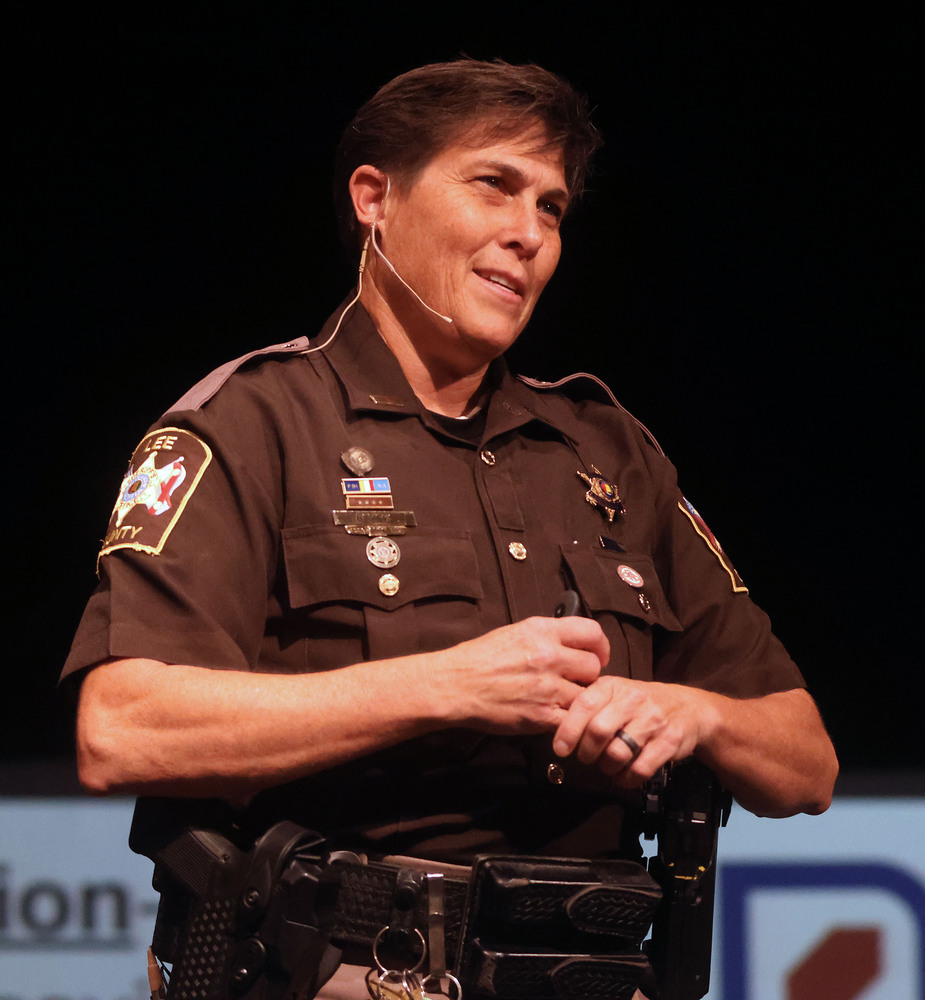
Pamela Revels, a Lieutenant of the School Resource Division with the Lee County Sheriff’s Office in Opelika, spoke on school safety Aug. 4 at the second day of employee Institute for the Thomasville City Schools District. The program was held in the Thomasville Civic Center.
Revels is a nationally recognized expert on school safety with 22 years of experience. She is a past president of the National Association of School Resource Officers and currently president of the Alabama Association of School Resource Officers (TAASRO). She is also on loan by the State Department of Education, which pays part of her salary to speak to educators.
“She is probably one of my favorite persons to listen to speaking on school safety,” said Adam Elliott, Safety and Family/Community Outreach Coordinator for Thomasville schools. “Not because that is her job or she is passionate about it. She lives it – every day of her life. …She is a top notch SRO (School Resource Officer).”
Her career began with an effort to teach students the dangers of drinking and driving. That led to applying to be a reserve deputy, but the job would evolve into the creation of a school resource deputy. “That has led me down this journey to where I am today.”
“You (educators) are so very important. …I know we go to school every day and we are going to teach ABC’s and 123’s. …Where we are today with school safety, you are also there to save lives.
“(You) save lives in two different ways,” she said. “Number one, (keep) that bad thing from happening, and number two, you may have that student who is not being fed. You may have that student who is being abused at night, and you could save their life and get them going down a road they thought they would never go.
“How important are you? …We are leaders and we are guides. You are leaders in your room and leaders in your building.”
Two years ago, NPR reported that school safety is a $4 billion industry, because parents expect school officials to keep their children safe, Revels said, “and come home the same way they left them mentally, emotionally and physically. …That is the burden you bear every day you walk into your schools.
“…What you do to keep that classroom safe every day is imperative.” Revels showed the example of the Sept. 4, 2024, shooting at Georgia’s Apalachee High School. Although the school administration stressed “shut, lock, secure doors,” a student left a classroom door open allowing the shooter an opportunity.
Revels also stressed the need for a “hard corner” area in each classroom where the teachers and students can stay out of the “line of sight” from the window in the door.
When it comes to safety for students and liability for the school system and employees, “what did you know, when did you know it, and what did you do about it? …The stakes are that high.” In a moment of extreme stress, will you be able to tell first responders on the phone what school hall you are on or what is your classroom number?
Constant training and school drills help students, teachers and staff prepare for those intense moments of crisis. Revels said school officials must regularly prepare for “what if” and “what would I do?” “You are the guides and the leaders and (the students) are going to look at you.”
She spoke of Kristina Anderson, a survivor of the 2007 Virginia Tech shooting, who said “at some point I got down beside my desk and I waited to die.” After hearing that Revels told herself, “no way will one of my students ever say they had to get down beside their desk and wait to die – because I did not prepare them.”
School officials are not only training students to survive a shooting incident at school but also an incident in their church, restaurant or Wal-Mart, she said.
“Prevention, intervention and response – that is how simple school safety is.”
Thomasville City Schools has spent over $500,000 on school safety in the last three years. Money spent on physical security is great, but the human factor is just as important, Revels said.
School officials need to observe the behavior of their students and if that behavior changes over the school year. “If someone shows a concerning behavior, what do you do with that? …What is your process?”
Revels also talked about how the crisis in school safety has resulted from the rapid decline of mental health and behaviors due to that. Intervention and being observant is crucial. The impact of social media, predators on the Internet, gang graffiti in the bathrooms, and student participation in “OnlyFans” sites are also factors. “What do I need to do to combat this sub-culture that I have?”
“The number one motive for targeted school violence is grievance,” she said. School officials have to take seriously what children say about fellow students. A second motive for school violence is suicide, and shooting suspects also crave notoriety. They will often mimic what other school shooters did.
“The connection you make with these young people is so very important,” Revels said. “It’s harder to shoot somebody if you like them. …We need to take them in and make them feel belonged – because one of the biggest things is isolation.”
After shooting incidents, people in the community will say they didn’t believe it would happen there, she said. “Not here,” they thought. “I challenge you to change these two words – instead of saying ‘no, it won’t happen here’ to ‘no, it won’t happen here because I want to do my due diligence - to do what I need to do to make sure it doesn’t happen here.”